
The Summer Garden (Episode One)
A Handful of Dirt

Just before we get started, I wanted to say a huge thank you to everyone who came along for the strange little ride that was Chaz GDP. What started as a goofy idea about an AI-run office somehow turned into ten weeks of mugs, malfunctions, workplace absurdity and, underneath it all, a surprising amount of heart. I had a tremendous amount of fun writing it and I’m grateful to everyone who read, commented, emailed, or simply quietly showed up each Sunday morning to spend a little time with Gary, Bradley P. Vickers, Dr. Park, and the increasingly alarming Chaz GDP system. Special thanks to Kathy Z.
But all stories end eventually, which means there’s room for new ones to begin.
Starting today, I’ll be sharing a brand new serialized story called The Summer Garden. This one is very different. Quieter. More reflective. Less about malfunctioning artificial intelligence and more about the strange ways people keep growing after loss, change, retirement, grief, and the ordinary wear and tear of living long enough to accumulate memories. At the center of the story is Bill “Scotty” Scotsford, a newly retired widower who moves into a condo across from a community garden and slowly finds himself becoming part of the lives growing there.
I have a feeling this one may mean a great deal to me while I’m writing it. I hope it means something to you while you’re reading it, too.
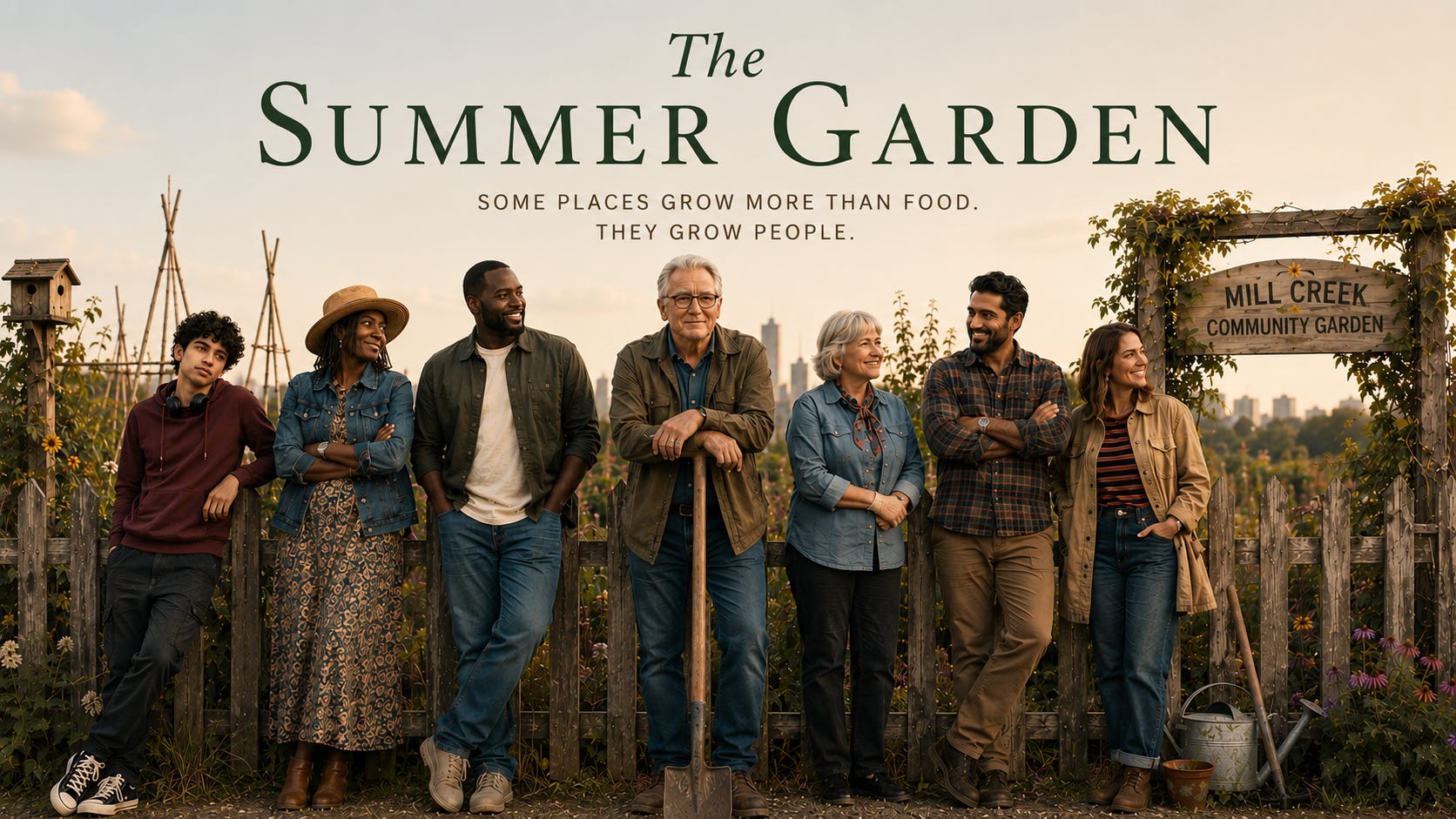
I was six years old the first time I put my hands into real dirt.
Not playground dirt. Not the hard-packed schoolyard stuff full of pebbles, cigarette butts, and the occasional Band-Aid that had lived a fuller life than most of us. I mean real dirt. Garden dirt. The dark, damp, almost-black kind that held together when you squeezed it and smelled like something ancient had just woken up.
My grandfather had a vegetable patch behind his garage, no bigger than a living room, but to me it felt like farmland. Rows of peas climbed up twine. Carrots hid themselves under feathery green tops. Potatoes grew in mounded hills that looked like burial sites for very small giants. I remember him kneeling beside me in an old blue shirt with the sleeves rolled to his elbows, his hands already stained brown in the creases.
“Go on,” he said. “Get in there.”
I looked at him as if he had asked me to climb into a bear cage.
“In the dirt?”
“That’s where gardens start.”
I pushed my fingers into the soil and felt it give way around my knuckles. Cool. Soft. Alive. A worm curled against the side of my hand and I yanked back with a noise I would later insist was a laugh, though my grandfather had the decency not to call me on it.
“Worms are good,” he said. “Means the soil’s healthy.”
I remember thinking that seemed like a lot of responsibility to put on worms.
That was my first lesson in gardening. The good things weren’t always the pretty things. Sometimes the good things were underneath, doing quiet work in the dark.
Of course, I forgot that lesson for most of my life.
My name is Bill Scotsford. William, technically, though nobody who loved me ever called me that unless I was in trouble or wearing a suit. Scotty started in junior high, hardened into permanence sometime around my first warehouse job, and followed me through thirty-eight years of adult life like a dog that had picked me and refused to be returned.
By the time I was sixty-two, I had answered to Scotty for so long that Bill felt less like my name and more like a man I had once planned to become.
My wife, Anne, called me Bill.
Not always. Not in public. In public, she used Scotty like everyone else, mostly because she enjoyed fitting in just enough to fool people. But at home, in the quiet places, when the kettle clicked off or the rain tapped against the kitchen window or she wanted me to stop pretending I was fine, she called me Bill.
“Bill,” she would say, “come look at this.”
And I would go.
That was marriage, I think. Not the big things. Not anniversaries, not vacations, not photographs where everyone smiles too hard and stands too close together. Marriage is being summoned from another room to look at a flower that wasn’t blooming yesterday.
Anne loved flowers. She loved shrubs and bushes and trees and anything that could become more beautiful by being left mostly alone, which may explain why she married me. She had a patience for things I never fully understood. If I planted something, I wanted results. Tomatoes. Beans. Peppers. Potatoes. Something you could hold in your hand at the end of the season and say, there, that was worth the sweat.
Anne could plant a stick and be delighted by the possibility of future shade.
Our first house had a yard the size of a postage stamp and soil that looked as if it had been imported from a construction site specializing in demolition. Anne loved it anyway. She spent that first spring kneeling in the beds along the fence, pulling rocks from the earth as if she were performing some kind of rescue operation.
I stood on the back step with a coffee in my hand and watched her.
“You know,” I said, “they sell flowers already grown. In pots. You could just put them there and save yourself the trouble.”
She glanced over her shoulder. Her hair had fallen loose from its clip and there was a streak of mud across one cheek.
“That’s not gardening.”
“It’s efficient.”
“It’s decorating.”
I sipped my coffee. “I’m a big believer in decorating.”
“No, you’re a big believer in avoiding blisters.”
Both things were true.
Still, over the years, she drew me in. Not all at once. Anne never pushed. She simply made room beside her and allowed curiosity to do the dirty work. At first, I carried bags of soil. Then I dug holes. Then I built raised beds because she said bending over was beginning to offend her lower back. Then one year she handed me six tomato seedlings and said, “These are yours.”
“What do I do with them?”
“Try not to kill them.”
“Is that the whole instruction manual?”
“For you, yes.”
I did not kill them.
That September, I picked the first ripe tomato from the vine and brought it inside like a newborn prince. Anne stood at the kitchen counter slicing cucumbers.
“Look at that,” I said.
She looked.
“It’s a tomato.”
“It’s my tomato.”
“It is.”
“I grew this.”
“With help from the sun, the rain, the soil, the worms, and the entire biological history of the planet, yes.”
“You’re jealous.”
“Deeply.”
I sliced it thick, salted it too much, and ate it standing over the sink because it was juicier than expected and I lacked both dignity and a plate. It tasted nothing like the pink tennis balls from the grocery store. It tasted warm. Green. Sweet. It tasted like my childhood.
After that, the backyard slowly divided itself into Anne’s kingdom and mine. Hers bloomed. Mine produced. She had lilies, hydrangeas, lilacs, roses, ornamental grasses, and one Japanese maple that she treated with more respect than some of our relatives. I had tomatoes, potatoes, peas, carrots, onions, squash, and a compost bin I talked about too much at parties.
We never had children.
For years, people asked. Some gently, some with the social grace of a raccoon in a pantry. At first we answered properly. Then vaguely. Then with jokes. Eventually, after the age when people finally stop asking whether you plan to reproduce, we discovered that the question had never really gone away. It had only changed shape.
Who would we leave things to?
Who would take care of us?
Who would remember us when we were gone?
Anne had answers for all of that, though she rarely gave them to the people asking. She remembered birthdays for coworkers’ children. She made soup for neighbors recovering from surgery. She kept emergency Christmas gifts in the closet in case someone turned up unexpectedly. She knew when the cashier at the grocery store was studying for exams, when the mail carrier’s dog died, and when my supervisor at work was pretending his divorce hadn’t flattened him.
I used to tease her about collecting strays.
She would say, “People aren’t strays, Bill.”
But some of them were.
Some of us were.
Anne had a gift for noticing who needed a little extra light and then standing near them until they remembered they could produce their own. I was less graceful about it, but I learned from her. We became, without ever discussing it, the sort of couple who fed people. Encouraged people. Listened longer than we planned to. Loaned tools we knew would not come back. Showed up with casseroles and moving boxes and jumper cables.
We nurtured because there was room in us for nurturing.
That sounds noble now, but it wasn’t. It was just where the love went.
Then Anne got sick.
Not dramatically at first. A tiredness she couldn’t shake. A pain she dismissed. An appointment. Another appointment. A specialist. A scan. A phone call that divided time into before and after.
People imagine illness as a battle because battles have shape. Sides. Strategy. Winners. Losers. Illness is more like the weather than a battle. It moves in. It changes the light. Some days are clear enough to fool you. Some days the roof comes off.
Anne handled it the way she handled everything, which is to say better than I did. She made lists. She asked questions. She thanked nurses by name. She apologized to me for being tired, as if fatigue were a personal failing and not her body dragging itself through fire.
The garden suffered that year.
Not all at once. Gardens are forgiving until they aren’t. The weeds came first, bold as squatters. The tomatoes sprawled because I never got around to tying them properly. The beans dried on the vine. Anne’s lilies bloomed anyway, indifferent to human crisis, which I resented at the time and understand better now.
Near the end, she asked me to bring her a flower from the yard.
It was September. Most of the garden had gone ragged around the edges, but one rosebush beside the fence had produced a late bloom, stubborn and ridiculous and red as a heart in a children’s book. I cut it badly, tore my thumb on a thorn, and brought it inside wrapped in a wet paper towel.
Anne was propped against pillows in the bed we had shared for thirty-one years. She had lost weight in a way that made her hands look too much like her mother’s. When I gave her the rose, she smiled.
“Look at that,” she whispered.
“It’s a rose.”
“It’s my rose.”
“It is.”
“I grew this.”
“With help from the sun, the rain, the soil, the worms, and the entire biological history of the planet, yes.”
Her smile widened. Barely. Enough.
“You remembered.”
I did.
I remember everything about those last weeks and almost nothing about them. Grief does that. It sharpens nonsense and blurs the rest. I remember the hum of the oxygen machine. I remember the smell of hand sanitizer. I remember washing coffee mugs because there was nothing else useful to do. I remember her asking me if I had eaten and lying when I said yes.
And I remember the morning after she died, standing in our backyard before sunrise with bare feet in wet grass, staring at the garden like it owed me an explanation.
It gave none.
Gardens don’t explain themselves.
They grow, or they don’t.
The funeral was held four days later under a sky so blue it felt disrespectful. People came. More people than I expected. Coworkers. Old neighbors. Friends we hadn’t seen in years. The grocery store cashier Anne had once helped with exam fees. A young man from down the street whose mother had worked nights and who had spent half his teenage years eating at our kitchen table. He was thirty now and had a beard and a baby of his own.
They hugged me. They cried. They told me Anne had changed their lives in small ways and large ones. I nodded because nodding was something my body still knew how to do.
At the graveside, the minister said words. I assume they were kind. Wind moved through the cemetery grass. Somewhere nearby, a crow argued with another crow about property rights or theology.
Then someone handed me a small silver trowel.
I looked down at the mound of dirt beside the grave.
It was dark. Damp. Almost black.
Real dirt.
For a moment I was six years old again in my grandfather’s garden, my fingers sinking into soil for the first time, a worm curling against my hand, the world still mostly ahead of me.
Then I was sixty-one, standing beside my wife’s coffin, with the world behind me in ways I had not agreed to.
I did not use the trowel.
I bent down and took a handful of dirt in my hand.
It was colder than I expected.
I held it longer than I should have. Long enough for my brother-in-law to shift his weight beside me. Long enough for someone behind me to quietly clear their throat. Long enough to understand that growing things and burying things had always been closer than I wanted them to be.
Then I opened my hand.
The dirt fell onto the coffin lid with a soft patter.
Not dramatic. Not cinematic. Just dirt returning to where dirt goes.
I thought I would feel something profound. Closure, maybe. Peace. Some small spiritual click as the universe put one terrible piece into place.
Instead, I thought: Anne would hate that I got mud on my good shoes.
And that was the first time I laughed after she died.
Not much. Not enough for anyone else to hear. But I did.
A year later, I sold the house.
People tell you not to make big decisions in the first year after a death. They say this as if grief comes with a warranty period and clearly marked instructions. Do not operate heavy machinery. Do not sign legal documents. Do not move furniture. Do not decide who you are now.
I listened.
For twelve months, I stayed in our house. The house that had become too large one room at a time. I slept on my side of the bed. I kept Anne’s gardening gloves on the shelf by the back door. I watered her shrubs badly. I threw out food that expired before I could finish it. I learned that silence has different textures depending on the hour.
Morning silence was survivable.
Evening silence less so.
The house had been ours. Without Anne, it became a museum curated by grief. Every corner held an exhibit. Here is where she laughed so hard she dropped a plate. Here is where she painted the wall the wrong shade of yellow and insisted it was cheerful, not alarming. Here is the kitchen drawer full of twist ties, batteries, seed packets, and three pairs of scissors no one could ever find.
The life insurance paid off the mortgage. That sentence made people nod as if it were good news, and in a practical sense, it was. Anne and I had saved carefully, too. We had planned to retire and see the world in the ordinary middle-class way. Not yachts and private villas. Coach seats, sensible shoes, photos in front of things older than Canada.
Scotland for me.
Italy for her.
New Zealand for both of us because we had watched too many movies and decided if hobbits could make walking look meaningful, so could we.
Now the money sat in accounts and spreadsheets, tidy and useless in the way abandoned plans always are.
I was lucky. I knew that. Financially, I could stop working if I was smart. I could live quietly. Carefully. I could retire.
Retire.
The word sounded peaceful until I got close to it. Then it sounded like being told to wait in a room where no one would call your name.
Still, I sold the house.
The young couple who bought it were expecting their first child. They walked through with the realtor, touching walls and opening closets, already filling our rooms with their future. The woman stood in the backyard and looked at Anne’s rosebush.
“Oh,” she said. “That’s beautiful.”
“It’s stubborn,” I said.
She smiled. “Good.”
I liked her for that.
On possession day, after the movers had taken what I wanted and strangers had hauled away what I could no longer bear to choose, I stood alone in the empty kitchen. Every sound echoed. The refrigerator was gone. The table was gone. The yellow wall remained, still cheerful, still alarming.
I walked through the house once.
Living room. Bedroom. Spare room. Basement. Back door.
In the yard, Anne’s side of the garden had come back better than it deserved. The lilac was blooming. The roses were in leaf. My vegetable beds were empty because I had not planted them that spring. I told myself I was too busy packing.
That was not the reason.
I took Anne’s old gardening gloves from the shelf by the door. They were stiff with use, the fingertips worn thin, the palms permanently shaped by her hands. For a few seconds I considered leaving them for the young woman who liked the rosebush.
Then I put them in my jacket pocket.
Some inheritances are too small to explain.
My new condo was on the third floor of a beige building in a suburban development where every street had a name that sounded like it had been chosen by committee after rejecting anything memorable. The unit had two bedrooms, one bathroom, underground parking, and a balcony just large enough for a chair, a small table, and the kind of potted plant that dies because no one respects it.
It was sensible.
That was the word everyone used.
“Sensible,” my financial advisor said.
“Sensible,” my sister said.
“Sensible,” I said to myself while unpacking dishes into cupboards that smelled faintly of someone else’s cinnamon.
From the living room window, I could see across the street to the community garden.
That was why I had bought the place.
Not the only reason. I told people it was the underground parking, the elevator, the manageable fees, the pharmacy nearby, the grocery store within walking distance, and the fact that I no longer wanted to shovel snow unless a judge ordered me to.
All true.
But the garden decided me.
It occupied a fenced rectangular lot between the condo complex and a walking path that curved toward a storm pond. From above, it looked like a patchwork quilt sewn by people with different opinions about straight lines. Raised beds. Hoop frames. Trellises. Barrels. Compost bins. A shed painted green. A row of sunflowers along the fence, though it was too early in the season for them to be anything but hopeful sticks.
The first night in the condo, I ate toast over the sink because I had not found the plates yet. Then I stood at the window until the sky went purple and watched a woman in a red jacket coil a hose beside the shed. A man in a ball cap pushed a wheelbarrow badly. Two kids chased each other between beds until someone I couldn’t see yelled at them to watch the onions.
Life was happening over there.
Messy. Ordinary. Inconvenient life.
I wanted nothing to do with it.
I wanted very much to be part of it.
For three days, I watched from the window like a widowed gargoyle.
I made coffee. I unpacked books. I arranged furniture. I rearranged furniture. I discovered the upstairs neighbor owned either a large dog or a small horse. I learned the washing machine had a spin cycle that sounded like it was trying to cross provincial borders. I found Anne’s gloves in the pocket of my jacket and sat on the edge of the bed holding them until the afternoon disappeared.
On the fourth morning, I woke before six.
The condo was quiet. Not house-quiet. Condo-quiet. A different species. Pipes clicking. Elevator murmuring somewhere down the hall. Someone’s shower running behind a wall. Other lives nearby but not touching.
I made coffee and took it to the balcony.
Across the street, the garden waited under a pale May sky.
Nothing dramatic happened. No shaft of sunlight broke through clouds. No voice spoke. Anne did not appear beside me in a cardigan to tell me to stop being ridiculous, though I would have welcomed the hallucination.
There was only the garden.
Dirt in boxes.
Fences.
A shed.
A crooked sign by the gate.
I went inside and put on jeans. Then a flannel shirt. Then boots I had kept though I no longer had a yard. I found Anne’s gloves on the dresser and almost took them, then left them there.
Not yet.
In the lobby, I checked the mail though I knew there would be none. Outside, the air smelled of cut grass, damp pavement, and somebody’s dryer vent doing optimistic things with fabric softener. Traffic whispered along the main road beyond the pond. A magpie strutted across the lawn like it owned property.
I crossed the street.
It took less than a minute.
That surprised me later, how close I had been to the next part of my life and how long I had managed to stand at the window pretending distance was the problem.
The sign on the gate read:
MILL CREEK COMMUNITY GARDEN
Plots Available
Please Contact Coordinator Before Planting
No Pesticides
No Stealing Tomatoes
Seriously, Dave
I liked the sign maker immediately.
Inside the fence, the garden looked less organized than it had from above, which made me like it more. Beds leaned. Labels faded. Someone had built a trellis from hockey sticks. A plastic owl with one missing eye guarded a row of seedlings with the tired menace of a retired nightclub bouncer.
Near the shed, a woman wrestled with a padlock.
She was about my age, maybe a few years younger, with gray hair pinned up badly and reading glasses hanging from a cord around her neck. She wore purple rubber boots and a jacket that had seen better decades. A clipboard lay on the ground beside her, held down by a rock.
“Come on, you miserable little bastard,” she muttered at the lock.
I stood by the gate, unsure whether to announce myself or retreat before becoming part of whatever this was.
The lock popped open.
The woman straightened triumphantly, then saw me and put one hand to her chest.
“Oh, hell. You scared me.”
“Sorry.”
“You always lurk at gates before seven in the morning?”
“Only when I’m trying to make a good first impression.”
Amusement glittered in her eyes as she looked me over. Not unkindly. Not softly, either. “You here about a plot?”
“I think so.”
“You think so?”
“I’m trying to keep my expectations low. That way, if I flee in panic, nobody’s disappointed.”
That got me half a smile.
“I’m Nora,” she said. “Garden coordinator, hose untangler, complaint department, and, apparently, locksmith.”
“Scotty.”
She held out her hand.
I shook it.
Her grip was firm, her palm cool from the morning air. There was dirt under one thumbnail.
That detail nearly undid me.
Not because of Anne exactly. Not only Anne. Because of my grandfather. Because of tomatoes eaten over the sink. Because of roses and hospital beds and yellow kitchen walls. Because life, inconsiderate as ever, had continued growing things while I was busy grieving what had been cut down.
Nora released my hand and bent to retrieve her clipboard.
“Well, Scotty,” she said, “let’s see what we’ve got left.”
She flipped through papers, frowned, licked one finger to separate a page, then seemed to remember the state of her hands and made a face.
“Plot seventeen is open. Good sun. Close to water. Soil’s decent if you don’t mind clay, and if you garden in Alberta and do mind clay, you’re going to spend a lot of time disappointed.”
“Seventeen,” I said.
“You want to see it?”
I looked past her at the rows of beds, the leaning trellises, the hopeful sticks, the one-eyed owl, the places where strangers had pressed seeds into soil because they believed something might come of it.
“Yes,” I said.
And for the first time in a year, the word did not feel like a courtesy.
Hope to see you next week for Episode Two.
Oh, my heart.
My grandfather, called Bampi because I could not say grandpa and I was the first grandchild, taught all of us about gardens. About the taste of baby cucumbers, warm from the sun and fresh off the plant. About the sweetness of tomatoes, plucked and eaten like apples. About good dirt and the right amount of water.
One of the first things I did when I bought this house seven years ago, was plan and plant a garden. It was a straw bale garden and it grew squash and tomatoes, cucumbers and green beans. I planted a bare-root rosebush that now climbs a trellis next to my office window and offers up yellow blooms edged with red. I planted three lilac bushes, two of which survived and one that has given blooms for four years. The other should bloom next year - I hope.
Peonies and hydrangeas, day lilies and irises brought in trash bags from my mom's house and planted on the hillside - dug from bulbs she had been given by Bampi and Nana from their house - the house my mother grew up in that Bampi had built with his own hands. Bampi and Nana have been gone many years now, but what they planted? That still grows.
These North Carolina mountains may be a world removed from my New England roots and that little house in Connecticut, but some of those roots transplanted beautifully...as did I.
The opening of this story threw me back to my childhood. My parents bought my Grandfather’s house and inherited the Concord grapes, currants, gooseberries, rhubarb rows , and an old apple tree. Plus the large vegetable garden. What your story really made me remember was my dad’s story about how grandpa always said sweet soil grew the best vegetables. I always thought that meant he must have tasted the soil. Maybe he did. When the onions were ready, grandpa brought out a knife and a slice or two of bread with him to the garden. A thick slab of warm just pulled onion completed his sandwich. Which I have to say did not sound delicious to me.