

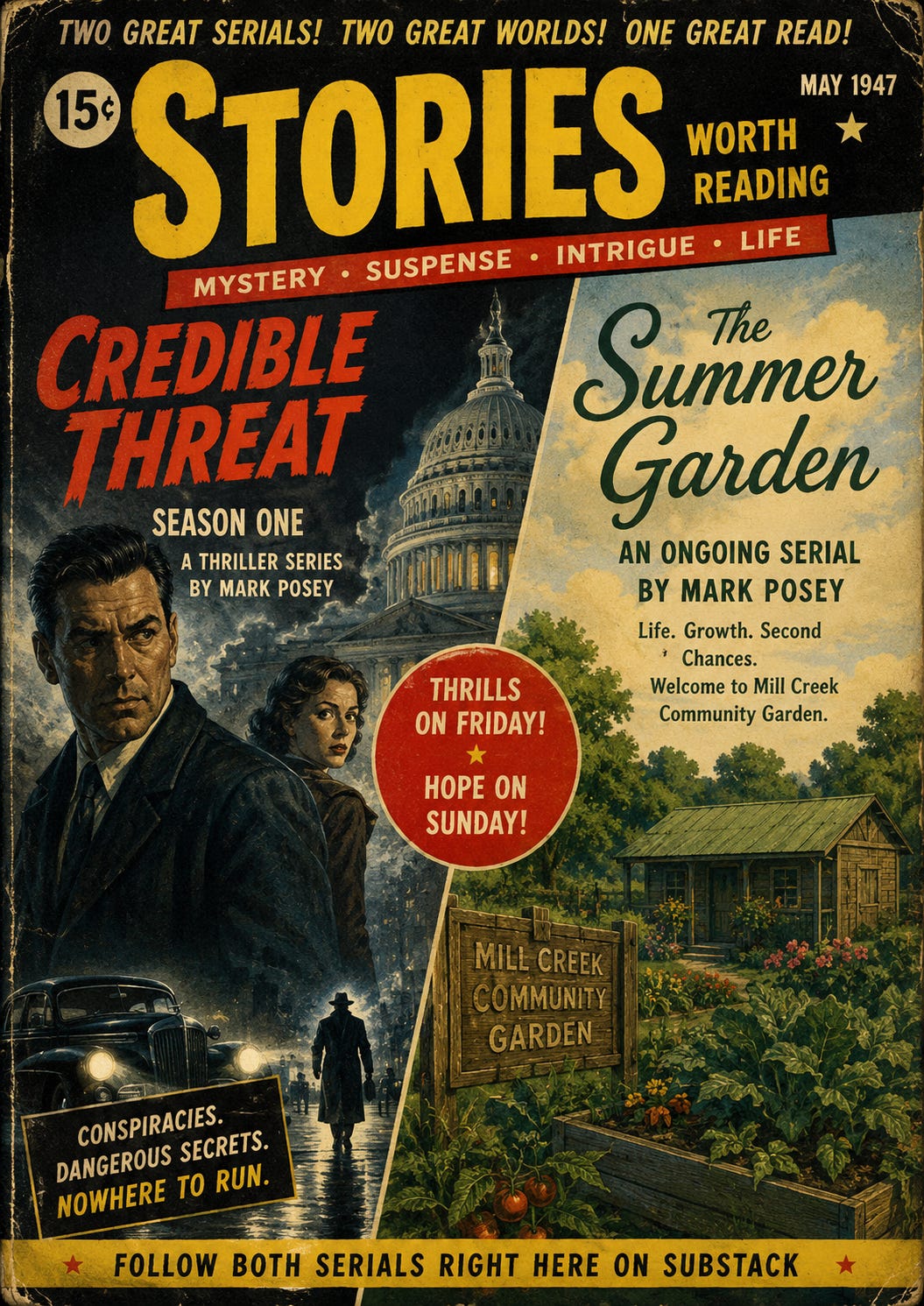
For the last few months, my weekends have been a little strange.
Every Friday, I published a new episode of Credible Threat: danger, violence, international intrigue, and Aaron and Marie trying to prevent some very bad people from doing some very bad things. Then Sunday rolled around and I switched to tomatoes, zucchini, broken hoses, coffee, and Scotty standing in Plot Seventeen trying to figure out what the hell he’s supposed to do with the rest of his life.
It occurred to me somewhere along the way that this might be a slightly unusual publishing schedule. Friday: Threaten the world. Sunday: Check the tomatoes.
The two stories could hardly look more different. Credible Threat is a thriller. Things happen quickly. The stakes are enormous. People are in danger, and decisions have consequences measured in lives.
The Summer Garden, meanwhile, is about a bunch of people with plots in a community garden. Nobody has to defuse anything. Nobody is racing against a clock to prevent catastrophe. Sometimes the big crisis really is a broken hose.
And yet, writing the two stories side by side taught me something I wasn’t expecting: they’re not actually all that different. Not where it matters.
Both stories begin by taking people who think they understand their lives and changing the rules on them. Then I get to watch what they do. Who do they trust? Who do they turn to? Who surprises them? What do they discover about themselves when the comfortable answers stop working? And, perhaps most importantly, who is standing beside them when things get difficult?
The size of the problem changes. The people don’t.
That realization matters to me because The Summer Garden began as an experiment. Tracy and I had been watching—and very much enjoying—the television series Shrinking. Somewhere along the way, I found myself thinking, That’s what I want to write.
I didn’t mean that I suddenly wanted to write about therapists in Pasadena. It was the people I was responding to. Messy people. Funny people. Hurting people. People who care about one another and frequently don’t know the right way to show it.
Tracy’s response was essentially, So why don’t you?
Fair point.
As I started planning the story, I realized there was something else I wanted to play with: the kind of introspective narration I’ve always loved in stories such as The Shawshank Redemption and Stand By Me. A narrator looking back and making sense of things, sometimes understanding the importance of a moment only after it has passed.
So I wrote The Summer Garden. And because apparently I don’t believe in easing gently into experiments, I published it at the same time as a thriller.
What surprised me was how comfortable it felt moving between them. I’d expected the two stories to exercise completely different writing muscles. Instead, I discovered I was asking many of the same questions.
I love a good plot. I love suspense. I love putting characters into situations where there doesn’t seem to be a way out and then making them find one. I’m certainly not finished writing thrillers.
But I’ve realized that the thing underneath all of that—the part I’m most interested in—is what happens to the people.
You can threaten someone’s life or their country. Or you can take away the person they’ve spent thirty-one years waking up beside and leave them standing alone in a community garden wondering what comes next. The scale is different, but the human part isn’t.
Maybe that’s why publishing these two serials side by side never felt quite as strange while I was doing it as it looks when I describe it now. On Fridays, I threatened the world. On Sundays, I grew tomatoes.
Turns out I was writing about people both days.
I have to confess that I haven't dipped into your world threatening serial, but I'm enjoying your growing tomatoes serial immensely. The way you describe personalities and emotions really resonates with me. Maybe when I've got a couple of hours free when I'm not doing my own writing, I'll dive back into your feed and read Credible Threat. Keep writing! Keep exploring!